
Access control doors for schools can recognise an authorised fob and release the lock, yet still leave a pupil struggling to pull open a heavy door. For a school business manager, that is an upgrade which has solved only part of the problem. The doorway needs to control entry and allow the people entitled to use it to pass through safely and independently.
Combining access control with automatic opening can address both needs. The important decisions concern the complete doorway: how someone requests access, where they wait, how the door moves and how it closes securely behind them.
For schools in Birmingham and across the Midlands, this guide explains what to consider when adding powered operation to controlled entrances and internal school doors, with practical questions to take into a site survey.
How automatic access control doors for schools work
Access control authorises entry. Door automation provides the movement. A complete installation brings the reader or reception release, electronic locking, powered operator and safety devices together.
In a typical arrangement, an authorised access request releases the lock before the operator opens the door. The door remains open for passage, with protective devices responding as designed, then closes and returns to its intended secure state. The exact sequence depends on the equipment and the agreed operating mode.
That coordination deserves attention. An opening command arriving before a lock has released can cause unreliable operation. Entry systems should also make the next action obvious: hearing a lock click does not tell the user whether they should pull the door, press another button or wait for it to open.
Ask the installer to demonstrate the whole sequence from both sides. A successful demonstration means someone can approach, gain access and pass through without needing an explanation at each stage.
Glassedge provides access control system installation in Birmingham and the Midlands, including integration with automatic and manual door hardware. For comparisons of fobs, keypads and other credentials, see our guide to access control systems for offices, schools and public buildings.
Design the journey through the doorway
Walk the proposed route with the people who use it. Involve the SENCO, site team and, where appropriate, pupils, staff or visitors with relevant access needs. A drawing can show a clear opening while missing the awkward turn needed to reach its control.
Can users reach the controls and wait clear of the door?
A wheelchair user needs to reach a reader or activation button without being trapped between the opening leaf and a wall. Someone using a walking aid may need space to stop, operate the control and move forward without stepping backwards.
Consider the approach from both directions, including nearby furniture, radiators, door recesses and queues. Mounting a button on the nearest available wall is not enough if that position makes the doorway difficult to use.
In early years or specialist settings, explain supervision needs to the designer. Moving every control higher to discourage pupil use can create a barrier for disabled adults or pupils. Access authorisation, supervision and accessible operation need a coordinated solution.
Does the opening time suit the actual route?
Consider the distance between the control and the doorway, the time needed to manoeuvre and whether a person travels with an assistant. Ask how the proposed system accommodates someone who moves slowly or pauses in the opening.
A longer fixed hold-open time is not a complete design strategy. Activation, protective detection, door speed and timing need to work together. Conversely, shortening the cycle to discourage someone following through should never undermine safe passage.
Is the whole route accessible?
A powered opener cannot remove a step, correct a difficult threshold or create turning space in a cramped lobby. Check the next door along the route too. Automating one entrance achieves little if an equally difficult manual door immediately follows it.
Approved Document M, Volume 2 provides guidance on access to buildings other than dwellings in England where the relevant building regulations apply. Assess the complete route rather than treating an automatic operator as proof of accessibility.
School accessibility planning also needs care. Government guidance on disability rights in education distinguishes schools’ duties to plan physical accessibility improvements from their reasonable adjustment duties for disabled pupils. An equipment choice should follow the identified need and the applicable duties.
Can existing school doors be automated?
In some cases, existing swing doors can be retained and fitted with powered operators. Suitability depends on the door and frame, available fixing positions, hinges, locking hardware, opening space and intended use. A door which catches, drops or fails to close properly needs its underlying problems addressed first.
For a school estate, assess each doorway individually. Similar-looking doors in different blocks may have different construction, fire performance or exposure to weather. A previous installation elsewhere on the site does not establish that the same equipment will suit every opening.
Double doors: check the width available in everyday use
A wide pair of doors can provide a much narrower usable route if only one leaf opens during normal operation. Ask which leaf or leaves will open for an authorised request, and have the resulting clear opening checked against the access requirements.
If both leaves need powered operation, the specification should address their coordination and, where required, closing sequence. Also establish how the doors will be used manually under the agreed fallback arrangements.
This is a useful point to settle before comparing quotations. A proposal for one powered leaf and a proposal for two may deliver quite different everyday access.
Plan for a school day, not just a quiet demonstration
A doorway that works for one adult during a survey may behave differently when a class approaches from both directions. Describe the situations the system must accommodate before deciding its operating settings.
| Situation | Question for the design brief |
|---|---|
| A visitor arrives at reception | Can reception authorise entry and give a clear indication that the powered door is ready to use? |
| A pupil uses a mobility aid | Can they operate the control, wait safely and pass through without somebody holding the leaf? |
| Pupils change lessons | How will two-way movement and groups be accommodated, including any agreed supervised operating mode? |
| An evening club uses one part of the site | Which doors need powered access, and how will staff confirm that the intended settings have been restored afterwards? |
| A powered doorway becomes unavailable | What accessible route or assistance arrangement will keep the school operating while the fault is resolved? |
Agree who may change operating modes. A temporary setting for deliveries or a supervised event can become a security weakness if nobody is responsible for restoring normal operation.
Automatic opening also cannot guarantee that only the authorised person passes through. Someone may follow another user or hold a door open. Reception procedures and supervision remain important, as part of the wider approach described in the Department for Education’s school and college security guidance.
Specify protection for the people using the doors
The risk assessment should reflect the age, behaviour and access needs of the school community. Discuss pupils approaching from different directions, people stopping in the doorway, wheelchair users and fingers near hinge gaps.
BS EN 16005:2023+A1:2024 covers safety in use for power-operated pedestrian doorsets. Ask the installer to explain how the proposed protective measures and commissioning checks address the risks at your particular doorway.
Activation devices and safety devices serve different purposes. A button may request opening; a protective sensor helps manage movement when someone is in a monitored area. The choice and positioning of safety devices, together with any finger protection, need assessment as part of the complete installation.
If a quotation describes the operator as low energy, ask what that means for this door and its users. Do not assume that the description settles every safety question or removes the need to assess additional protection.
Fire alarms, power failures and lockdown need separate answers
Request a written explanation of what each door and lock will do during normal operation, a fire alarm, loss of power and any school lockdown procedure. These situations should be reviewed together by the relevant competent people.
Electronic unlocking and powered opening are separate functions. Releasing a lock does not necessarily make a heavy door easy to move, while a backup supply for an operator does not by itself establish suitable emergency escape arrangements.
The Government’s fire risk assessment guide for educational premises addresses escape arrangements and electronically controlled doors. People must be able to escape safely without relying on a staff fob or a receptionist releasing the door.
A fire-resisting door may need to close to protect a compartment while remaining usable for escape. If existing fire doors are being altered, have the compatibility of the doorset, operator, locking and other hardware checked. Avoid a blanket instruction that every school door should open on a fire alarm.
A practical example: powered doors at Hereford Sixth Form College
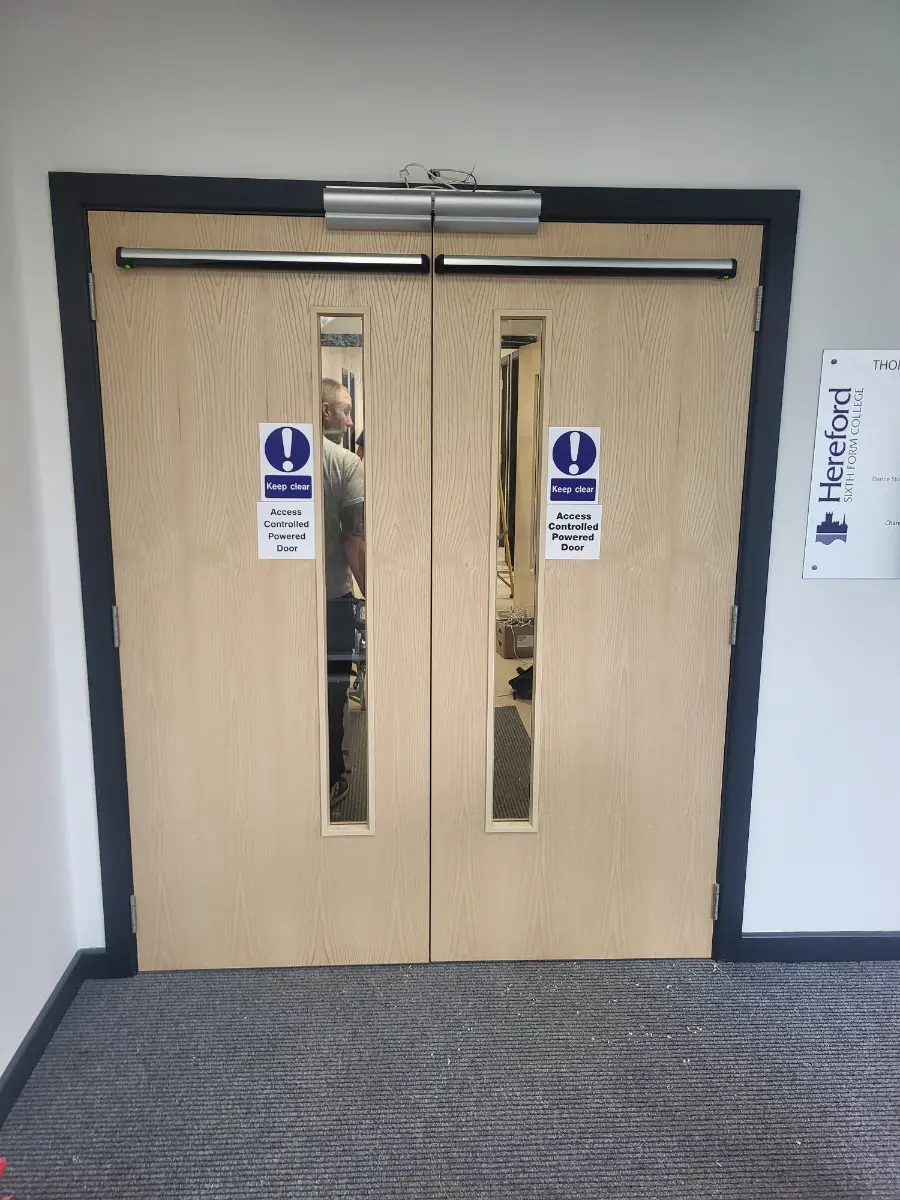
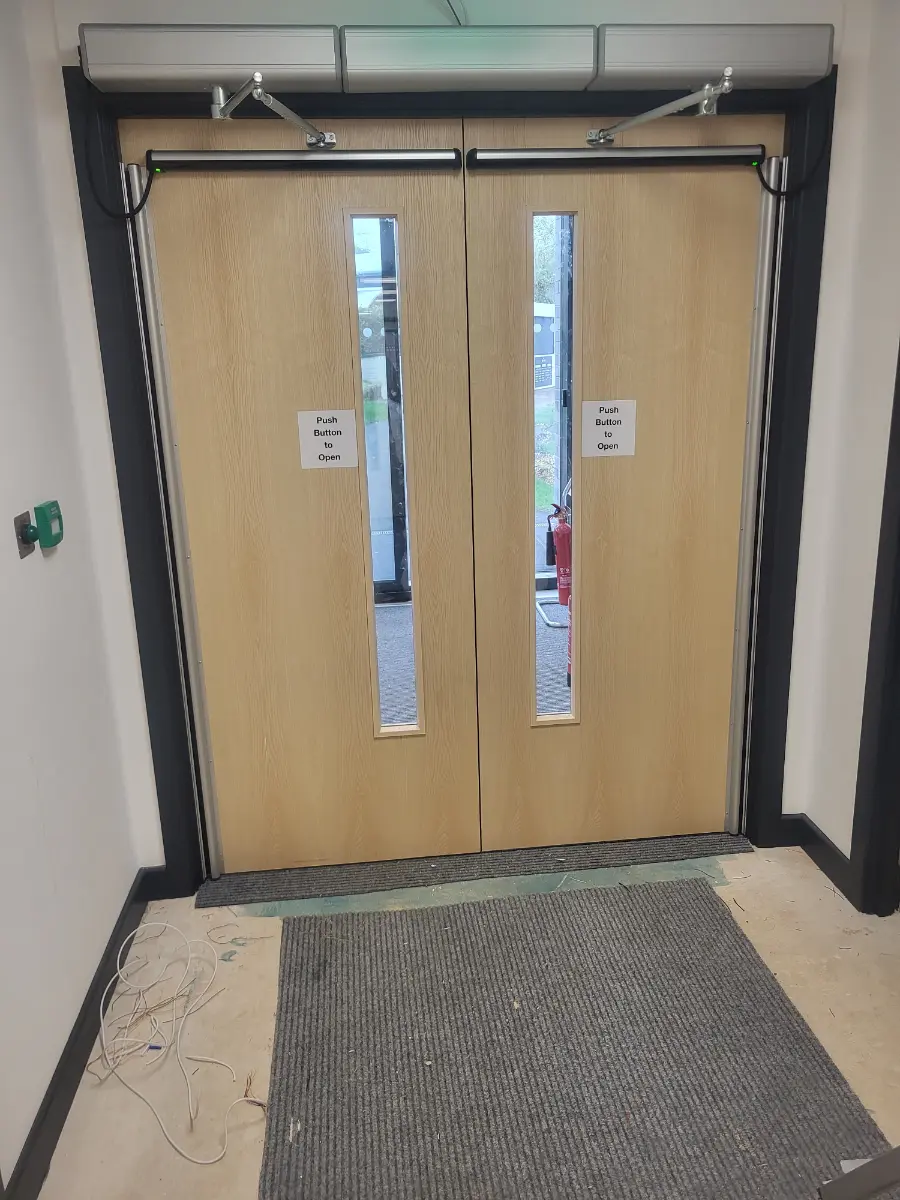
Glassedge’s photographs from work at Hereford Sixth Form College show timber double doors with overhead powered operators and door-mounted sensor bars. The signs identify access-controlled powered doors and push-button opening.
The useful detail is how much of the installation sits around the existing doorway. The door leaves, overhead equipment, protective devices and user instructions all contribute to how someone experiences the opening.
For a school considering a similar arrangement, the photographs provide a starting point for discussing powered swing doors. The final specification still needs to establish the required opening width, access sequence, safety measures and emergency behaviour for that location.
Compare the complete installation and agree who owns each task
A useful quotation should explain what will be delivered at each doorway. Establish whether it covers door repairs, one or two operators, electronic locking, controls, protective devices, electrical work, system integration, making good and commissioning.
The price also depends on what can be retained. Existing access control may be suitable for integration, but compatibility needs checking. Ask whether changes to the controller, wiring, power supply or software are included, and identify any ongoing charges.
Where the access control provider, door installer, electrician and fire alarm contractor are different organisations, name who will coordinate the interfaces and final testing. Otherwise, a school can receive several working components without anyone having demonstrated the complete system.
Before booking the work, agree the temporary entrance, accessible route and separation of the work area from pupils. Holiday installation may be useful, but clubs, examinations and community bookings can still affect access. Confirm how the building will be secured if the work extends beyond one visit.
Make handover a practical demonstration
Ask the installer to demonstrate the agreed operating scenarios with the site team and relevant users before the doorway enters normal service. Include normal access from both sides, reception release where fitted, the approved manual arrangements and the specified emergency responses.
Keep the following together in the school’s premises records:
- The agreed door settings, operating sequence and responsibilities for changing them.
- Commissioning and safety records, relevant conformity documentation and equipment instructions.
- Routine user checks, staff training and the procedure for reporting faults.
- Warranty details, maintenance arrangements and support contacts.
Agree a review once the doorway has been used during a normal school day. Feedback may reveal queuing, confusing controls or approach difficulties that were less apparent during installation. Any adjustments should be made by the appropriate competent person.
Maintain security and accessibility after installation
Give the site team a clear reporting route for doors which hesitate, strike the frame, move unexpectedly or fail to return to their intended secure state. Follow the agreed safety procedure for an unsafe door, including how access and escape will be maintained while it is out of use.
Arrange servicing around the manufacturer’s instructions, usage, condition and risk assessment. The Automatic Door Installation Association’s maintenance guidance explains that there is no single universal legal servicing interval for every automatic pedestrian door.
Review the doorway when its surroundings or users change. A new display, reception desk or storage position can affect the approach or operating area. A change from staff-only use to pupil use also deserves reassessment.
If an existing powered entrance is unreliable, Glassedge’s automatic door repairs, servicing and maintenance service can help establish the cause and appropriate remedial work before the school commits to replacement.
Discuss your school’s doors with Glassedge
Start with a clear description of the difficulty: a heavy reception door, an internal pair which provides insufficient usable width, or an access-controlled entrance that users cannot open independently. Photographs of both sides, your postcode and details of the current entry system will help the initial discussion.
For access control doors for schools in Birmingham and across the Midlands, Glassedge can discuss the doorway, powered operation and access control together. Request advice and a tailored access control quotation based on your school’s building and everyday use.
Frequently asked questions about automatic school access control doors
What is the difference between an access-controlled door and an automatic door?
Access control decides whether an entry request is authorised and controls locking. An automatic operator moves the door. Combining them can allow an authorised person to enter without pulling or pushing a heavy leaf, provided the complete system is designed for that use.
Can existing timber school doors be fitted with automatic openers?
Some can. A survey needs to assess the doors, frames, hinges, fixing positions, opening space and locking, along with any fire performance requirements. Repairs or hardware changes may be needed before powered operation is suitable.
Do both leaves of double school doors need to open automatically?
That depends on the required clear opening and how the doorway is used. One powered leaf may be sufficient in some locations; others may need both. The survey should establish the usable width in normal operation and any required coordination between leaves.
Can reception release a school door and open it automatically?
A compatible integrated system can be designed to release the lock and activate the powered operator following an authorised reception command. Specify how reception supervises entry and how visitors know when to proceed.
Will automatic access control doors still work during a power cut?
The response depends on the operator, locking, power arrangements and agreed design. There may be backup-supported operation, manual use or another specified arrangement. Have the installer explain and demonstrate the actual response, with accessible movement and emergency escape considered separately.
How much do automatic access control doors for schools cost?
Costs depend on the number and condition of the doors, the required powered leaves, locking, protective devices and integration work. Ask for an itemised quotation covering the complete installation, commissioning and ongoing support rather than comparing operator prices alone.
How often should automatic school doors be serviced?
Follow a maintenance schedule set for the equipment, its usage and the risk assessment, taking account of the manufacturer’s instructions and previous faults. Keep records, complete the routine user checks specified at handover and act promptly on defects.