
Heavy church doors can make a welcoming building difficult to enter. A wheelchair user may need someone to hold the door, a visitor with arthritis may struggle with the handle, and volunteers may end up propping the entrance open. For churchwardens and trustees, improving that entrance means balancing independent access, security, the building’s character and a carefully managed budget.
Automatic doors and entry systems can help, but replacing the whole entrance is not always necessary. The right approach starts with understanding what your existing doors can do, who uses them and how the church operates throughout the week.
This guide explains the choices for churches in Birmingham and across the Midlands, including when to retain existing doors, how access control works and what to ask before commissioning an upgrade.
What should an upgrade to church doors actually achieve?
Begin with the difficulty you want to solve. “The entrance needs modernising” is a broad ambition. “People cannot open the inner doors without help, and hall hirers need access outside office hours” gives an installer something useful to work with.
Walk the route from the pavement or car park into the building with people who use it. Include disabled congregation members and visitors rather than relying entirely on assumptions about their needs.
Look beyond the door leaf. A powered opener will not remove a step, widen a narrow opening or make a push button reachable from a wheelchair. In a porch with two sets of doors, solving the outer entrance alone may leave the main barrier untouched.
Consider busy occasions as well as quiet weekdays. A door that works adequately for one person may create a queue after a service or become awkward when people arrive with pushchairs, walking aids or equipment for a community event.
A useful brief describes three things: the access problem, the building constraints and the way the entrance needs to operate.
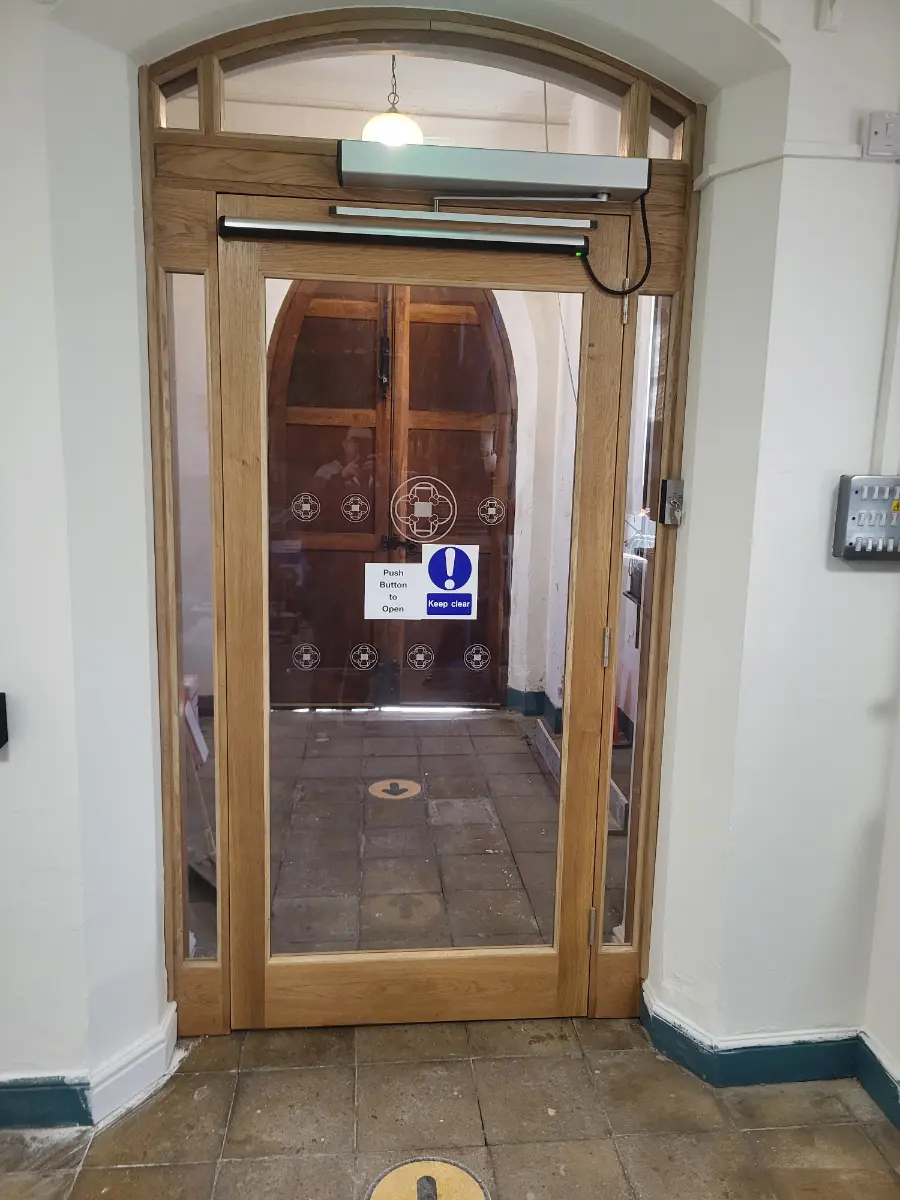
Automatic doors and entry systems: what is the difference?
Door automation moves the door. Access control decides whether someone is authorised to open it. They can work together, but they solve different problems.
An automatic swing door might open when someone presses an accessible button. An access-controlled entrance might unlock when a churchwarden presents a fob. An integrated system can check the fob, release the lock and then power the door open in sequence.
This distinction matters when obtaining quotes. A keypad fitted to a heavy manual door may improve security without making entry easier. Equally, a movement sensor that opens a door for everyone does not provide controlled entry.
Glassedge’s automatic door installation service in Birmingham and the Midlands covers entrance automation, with options that can be considered alongside access control.
Can existing church doors be automated?
Sometimes. An automatic swing door operator can be a suitable way to retain existing doors while reducing the effort needed to use them. Suitability depends on the complete entrance, not simply whether there is room above the frame for a motor.
A survey should examine the door’s weight and condition, hinges or pivots, frame strength, available fixing positions, opening width and exposure to wind. The operator, locking hardware and safety measures must work as a system.
If a timber door catches on the floor, its frame has moved or its hinges are worn, adding automation will not cure the underlying defect. Repairs may be needed first. A particularly exposed entrance may also need a different approach from a sheltered inner porch door.
For paired church doors, ask whether one leaf provides enough usable width or both need to operate. A nominally wide opening can still be restrictive if visitors routinely use only the narrow active leaf.
Where the main historic doors are unsuitable, an architect and installer may be able to explore a separate inner entrance. That option still needs careful assessment of space, appearance, access and permissions.
Automatic swing or sliding doors: which suits your church?
Neither arrangement is the default choice for every church. The porch layout, pedestrian route and condition of the existing entrance usually narrow the options.
| Option | When it may suit | What needs checking |
|---|---|---|
| Automating existing swing doors | The doors are sound and retaining their appearance is a priority. | Door weight, fixings, wind exposure and a safe, clear swing area. |
| New automatic swing doors | The existing doors need replacement and the layout accommodates a swinging leaf. | Opening direction, usable width, approach space and compatibility with the building. |
| Automatic sliding doors | A swinging leaf would obstruct movement, and there is space for panels to slide aside. | Side space, supporting structure, glazing design and any escape-route requirements. |
| Repairing an existing automatic entrance | The layout works, but operation has become unreliable. | The cause of faults, safety condition, parts availability and likely remaining service life. |
For swing doors, the position of the activation button deserves particular attention. Someone should be able to reach it without waiting in the door’s opening path. For sliding doors, check that furniture, displays and stored equipment will not intrude into the operating area.
If you are unsure whether your entrance needs repairs, automation or replacement, ask Glassedge to discuss the existing arrangement before committing to a specification.
Choosing access control for worship, visitors and hall hirers
Church entry systems need to reflect a changing week. You may want unrestricted entry for Sunday worship, controlled access for an evening group and a secure building when nobody is present.
Write down those operating situations before choosing equipment. Include who opens up, who locks up and what happens when a booking overruns.
Fobs, keypads and intercoms
Fobs can be practical for regular volunteers and authorised hirers. Where the system supports individually managed credentials, a lost fob can be cancelled without replacing everyone’s access device. Someone still needs responsibility for issuing, reviewing and withdrawing permissions.
Keypads avoid handing out physical devices, but a shared code can spread beyond its intended users. Ask whether separate or time-limited codes are supported and whether volunteers can manage them confidently. Our guide to keypad entry systems explains further considerations.
An intercom lets visitors request entry, provided somebody is available to answer. A building open for private prayer without an attendant needs a different arrangement from a staffed church office. Think about how a visitor who cannot hear or use a conventional intercom would gain access.
Control access to the right parts of the building
A hall booking does not necessarily require access to the church office, vestry or every internal room. Separating access areas can be more useful than making the main entrance increasingly complicated.
Access control also has limits. An authorised person can hold a door for somebody else, and a door propped open bypasses the lock. Equipment should support sensible supervision and safeguarding procedures rather than create an assumption that everyone inside has been checked.
Ask whether the proposed system needs an internet connection or subscription, what continues working offline and how administration passes to a new churchwarden. Straightforward handover matters when the people managing the building change.
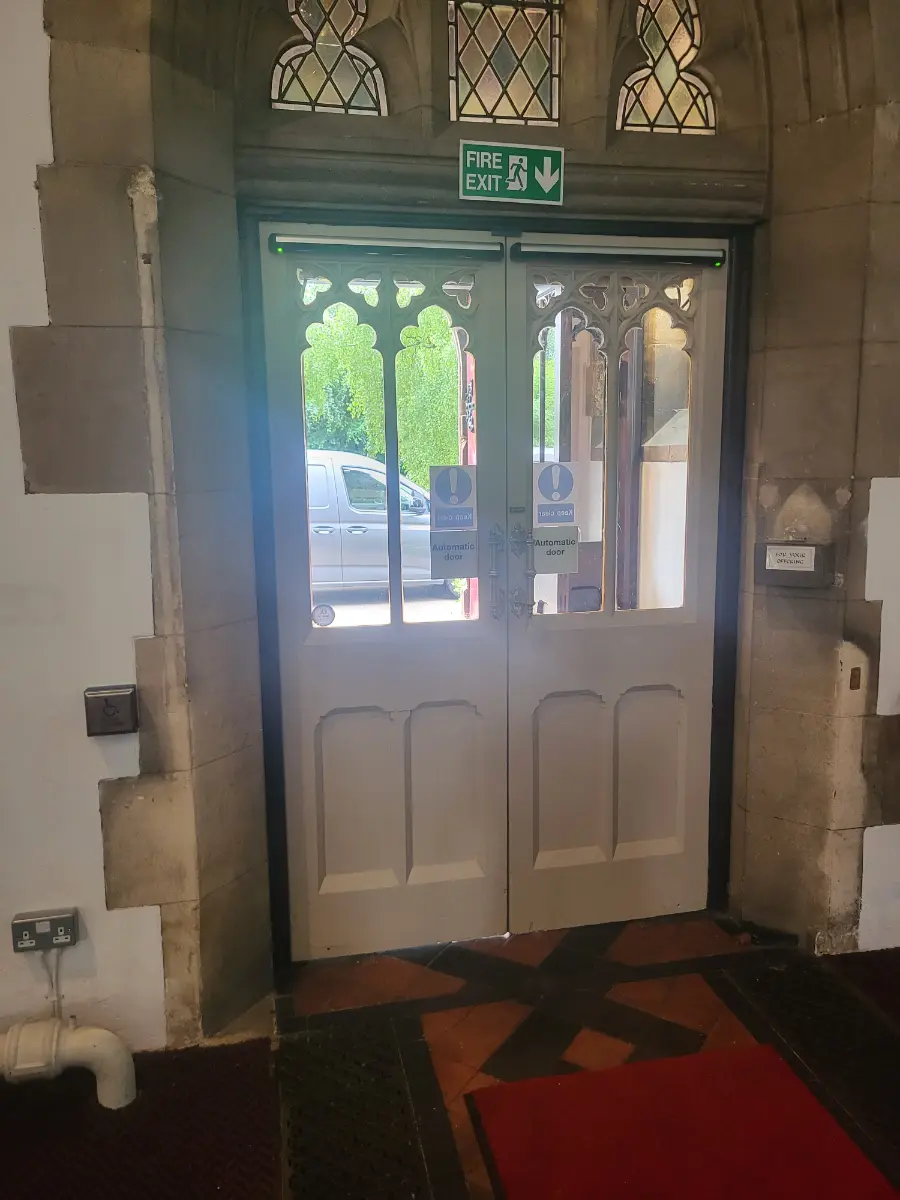
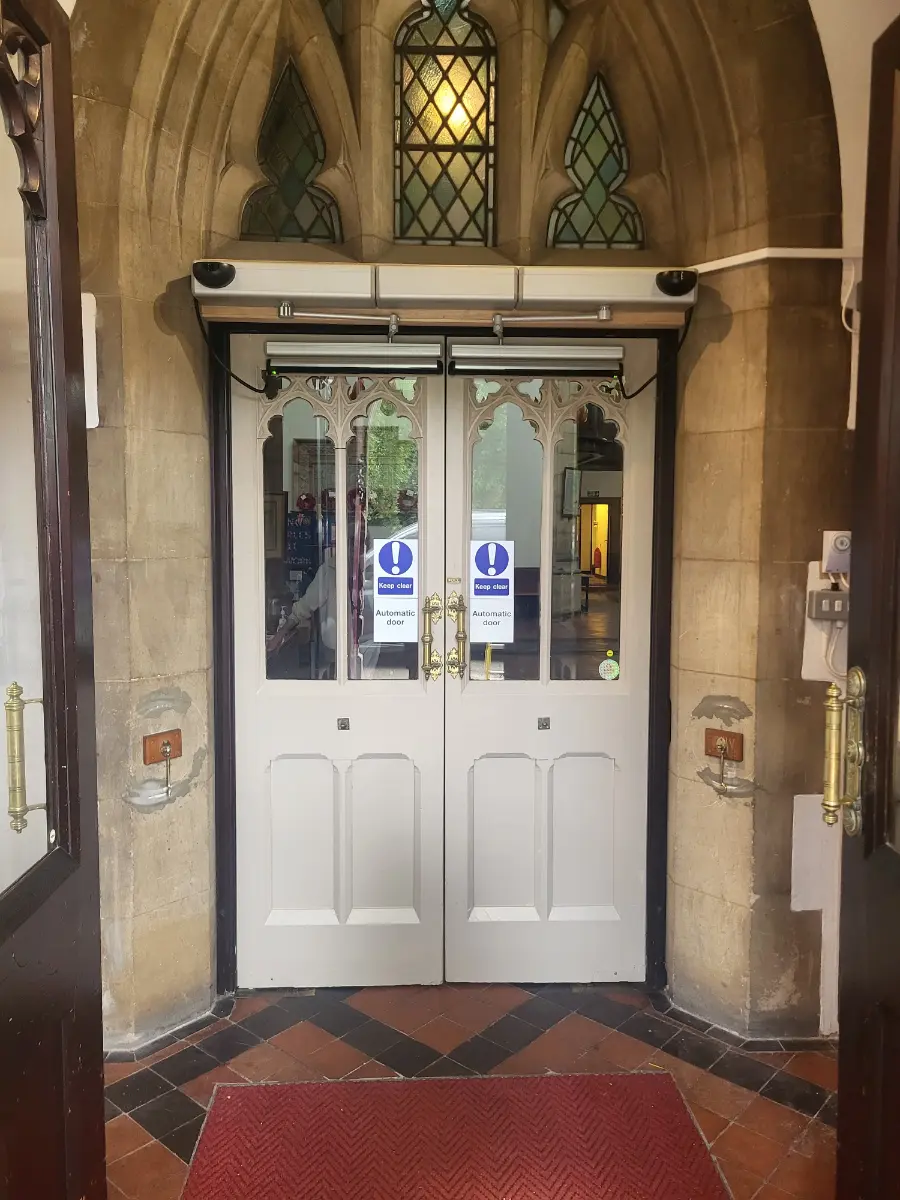
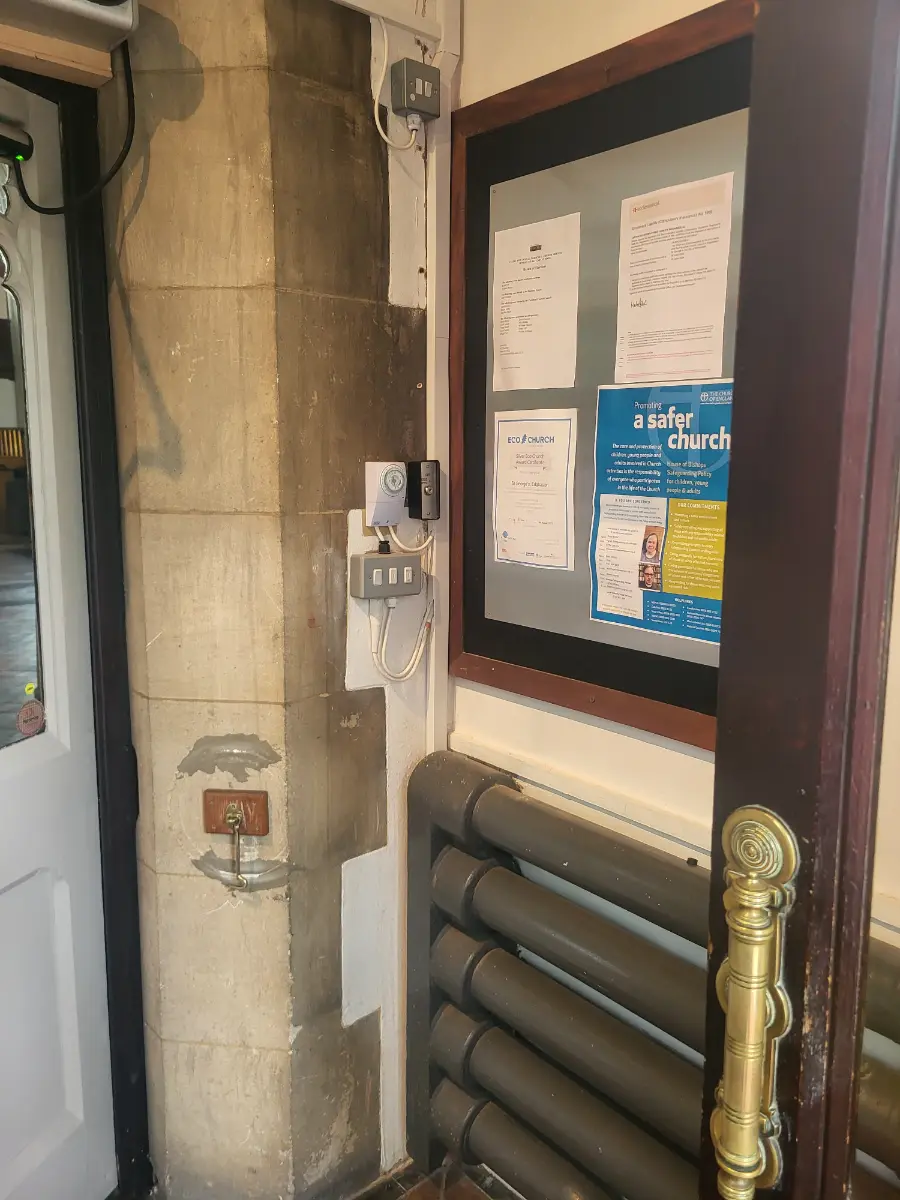
Accessibility, permissions and automatic door safety
Does a church have to install automatic doors?
There is no blanket requirement for every church to install automatic doors. The Equality Act 2010 requires reasonable adjustments for disabled people where the duty applies. What is reasonable depends on the circumstances; automation may form part of the solution.
The Church of England’s accessibility guidance recommends assessing barriers and developing an access plan. Consider the whole journey through the building, including thresholds, circulation and controls.
Where building work falls within the relevant requirements, Approved Document M, Volume 2 provides guidance on access to buildings other than dwellings in England. An automatic opener alone does not establish that the entrance or building meets every applicable requirement.
Check permissions before ordering equipment
For Church of England buildings, involve your Diocesan Advisory Committee early to establish the permission route. A faculty may be needed for alterations, including some work to unlisted churches. Other denominations have their own approval arrangements.
Planning permission, listed building consent or building regulations approval may also need consideration, depending on the building, proposed work and any applicable ecclesiastical exemption. Ask your church architect or relevant adviser to confirm what applies before installation is booked.
Historic features do not automatically rule out access improvements. They do make the position of operators, cabling, buttons and fixings important. Historic England’s guidance on access to historic buildings is a useful starting point for discussing options.
Specify safety for the people using the entrance
BS EN 16005 covers safety in use for power-operated pedestrian doorsets. Ask the installer to explain the risk assessment, protective measures and commissioning checks for your entrance.
A church entrance may be used by children, people moving slowly and visitors unfamiliar with automatic doors. The Automatic Door Installation Association identifies impact, crushing and other moving-door hazards that require appropriate assessment and protection.
Opening speed, hold-open time, sensors and finger protection need to be considered together. Clear markings on glazing and understandable operating signs also help people recognise and use the entrance.
What happens during a fire alarm or power cut?
Ask the installer to describe the proposed door and lock behaviour during normal use, a fire alarm and a loss of power. These are different situations, and the answer depends on the equipment and the building’s fire strategy.
A battery backup does not, by itself, establish that an escape route is suitable. Nor should you assume every powered door opens automatically when the electricity fails.
The Government’s fire safety guidance for small and medium places of assembly, which includes churches, explains the need for escape doors to be readily openable. People should not need a key, fob or code to make their escape.
Have the proposed automation, electronic locking and any alarm interfaces reviewed against your fire risk assessment by a competent person. If an existing fire-resisting door is being altered, its protective function must also be considered. A fire-resisting door and a final exit door have different roles, even where one doorway performs both.
A church entrance upgrade in practice: St Andrews, Cheltenham
At St Andrews United Reformed Church in Cheltenham, the existing floor-sprung glass entrance doors were heavily used and their locks had become difficult to operate.
Glassedge replaced the entrance with a bi-parting sliding glass door system, together with new side panels and a fanlight. The installation incorporated radar and threshold sensors, and the published project description includes staff fob controls. Glass markings were reinstated to improve visibility.
The useful lesson is the starting point: an entrance with practical problems needed an assessment of doors, locks and everyday use together. Read the St Andrews church sliding door installation case study for the project details. Its specification should not be treated as a template for another church’s access or escape arrangements.

Budgeting for church doors: compare the complete scope
A reliable price needs a survey. Automating sound existing doors and replacing an entire glazed entrance are different projects, so a single “cost of automatic church doors” figure can be misleading.
Ask for a written quotation that makes the following clear:
- Door work: repairs or replacement, frame alterations, glazing and making good.
- Automation and security: operators, safety devices, activation controls, locks and access credentials.
- Associated work: electrical supply, cabling, any alarm integration and work by other contractors.
- Handover and ownership: commissioning records, training, warranty terms, servicing and any software or subscription charges.
Confirm whether VAT and professional or permission-related fees are included or excluded. Compare the same scope across quotations, particularly where one price assumes that electrical work or repairs will be arranged separately.
For a restricted budget, ask what can sensibly be phased. Repairing a sound entrance may be appropriate now, with further access improvements planned later. Safety-critical work needs to be addressed as part of the immediate decision.
Automatic operation may reduce the need to leave doors propped open, but heating savings are not guaranteed. Opening frequency, draughts, seals and the porch layout all affect the outcome.
Plan installation and maintenance around church life
Share the church diary before agreeing an installation date. Weddings, funerals, services and community bookings may need an alternative entrance while work takes place. Establish how visitors will be directed and how access will be maintained.
At handover, ask for a demonstration for more than one responsible person. Cover everyday settings, locking up, fault reporting and the agreed response to a power failure. Keep instructions and access administration details available to future trustees and building managers.
Agree a servicing schedule based on the manufacturer’s instructions, usage and risk assessment. There is no single statutory servicing interval that applies to every automatic pedestrian door, as the ADIA’s maintenance guidance explains.
Have a named person carry out the routine user checks specified at handover and keep service reports and fault records. Report changes such as jerky movement, unusual noise or unreliable detection promptly. Follow the agreed procedure for keeping an unsafe door out of use while maintaining safe access and escape.
If your existing system is unreliable, Glassedge provides automatic door repairs, servicing and maintenance. Diagnosis can establish whether a repair is sensible before you budget for replacement.
Discuss your church entrance with Glassedge
Glassedge is based in Birmingham and works across the Midlands, providing automatic door installation, repairs and access control. To start a useful conversation, send photographs of both sides of the entrance, your postcode and a short description of the problem. Mention any known listed status, existing automation and how the building is used.
The right upgrade makes church doors easier to use and manageable for the people responsible for the building. Whether you need to retain traditional doors, replace an unreliable entrance or introduce controlled entry, contact Glassedge for advice and a tailored quotation, or call 0121 439 0682.
Frequently asked questions about church doors and entry systems
Can automatic openers be fitted to existing wooden church doors?
They can be suitable where the doors, frames and fixings are sound and the layout allows safe operation. Door weight, wind exposure, hinges, locking and any heritage restrictions need assessment. Repairs may be required before automation is considered.
Are automatic doors compulsory for churches?
No blanket rule requires every church to fit automatic doors. Churches must consider their applicable reasonable adjustment duties under the Equality Act 2010. Automation is one possible response to an identified access barrier, alongside other changes to the entrance or building.
Do we need permission to automate doors in a listed church?
Check before proceeding. The approval route depends on the denomination, building and proposed alterations. Church of England parishes should consult their Diocesan Advisory Committee; other churches should contact their relevant property authority and professional advisers.
Can church entry systems give hall hirers access at set times?
Some access control systems support scheduled fob permissions or time-limited codes. Specify the booking arrangements before choosing equipment, including who changes permissions and what happens if a group arrives early or leaves late.
Will automatic church doors still work during a power cut?
Behaviour varies by system. Depending on the design, there may be battery-supported operation, manual operation or another defined response. Ask for the exact arrangement to be explained and demonstrated, with escape requirements considered separately.
How much does it cost to install automatic doors at a church?
The cost depends on whether existing doors can be retained, the equipment needed and any structural, electrical or access control work. A site survey and itemised quotation are more useful than a general price that leaves out essential parts of the job.
How often should automatic church doors be serviced?
Follow a schedule established from the manufacturer’s recommendations, the entrance’s use and its risk assessment. Busy community entrances may need more attention than lightly used doors. Keep records and act promptly on faults rather than waiting for the next planned visit.